
Resensi ini terbit di Abjad: Journal of Humanities & Education 3 (3), 2025: 238-240
Oleh DHONI ZUSTIYANTORO
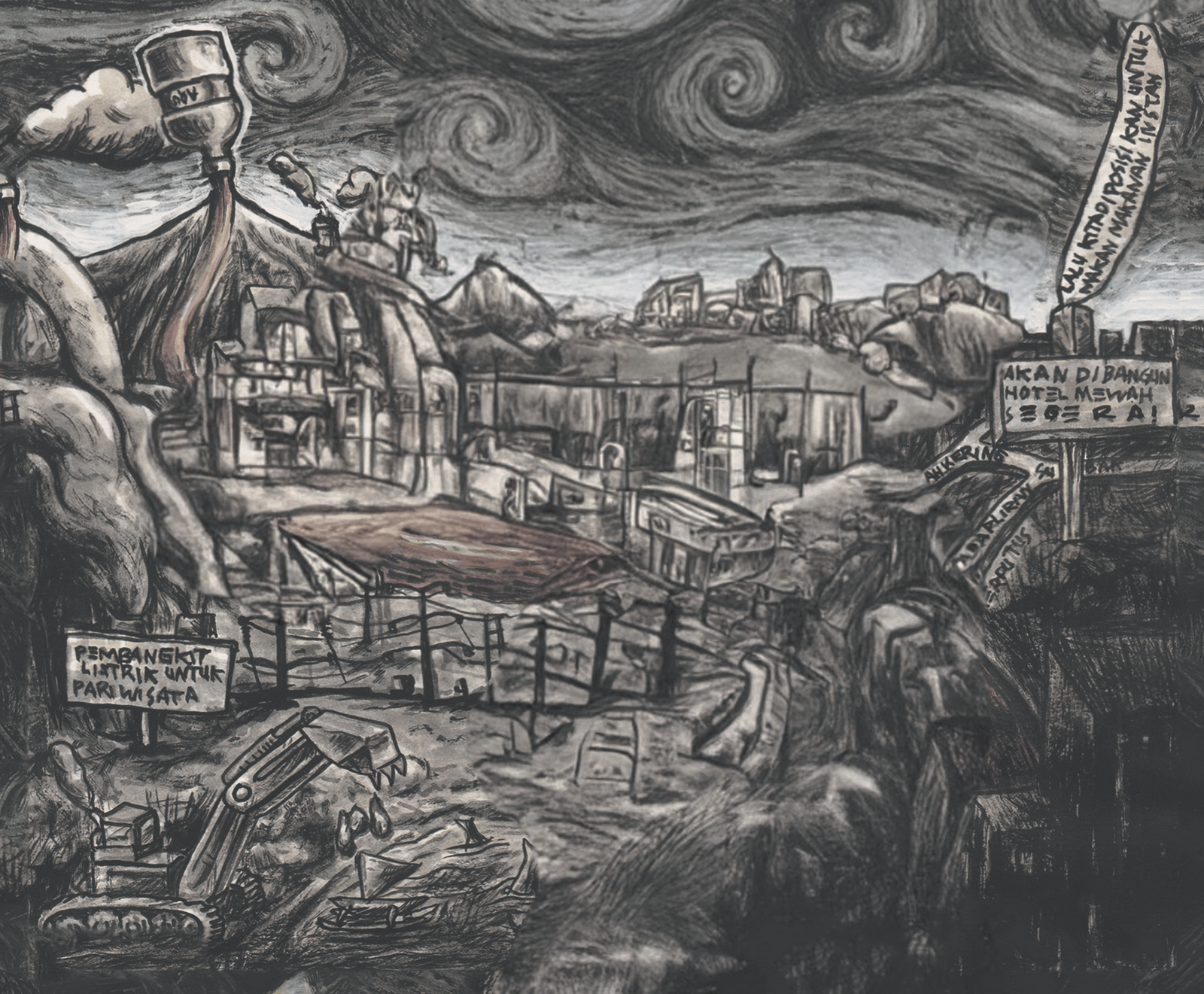
Bali, an enchanting island, has long been a magnet for visitors to Indonesia. With its rich natural and cultural heritage, the island has evoked an exotic imagination that has attracted global attention since the colonial era. However, the commercialisation of Bali has also given rise to complex spatial governance challenges, leading to prolonged social conflicts driven by the economic and political interests of entrepreneurs, politicians, and government officials. In his book, Berebut Bali: Pertarungan atas Ruang & Tata Kelola (Contesting Bali: The Struggle Over Space & Governance (2024), Agung Wardana presents a comprehensive analysis.
Chapter 1 of this book examines Bali’s crisis through three distinct perspectives. First, scholars perceive the crisis as a rational choice driven by the costs and benefits of maximising individual profit. Second, a conservative approach attributes the crisis to external forces like globalisation. Third, an institutionalist perspective argues that the crisis stems from transforming governance structures from centralisation to decentralisation, transferring authority from the central government to districts and municipalities in Bali.
Chapter 2 delves into Bali’s historical trajectory within the context of political development. Initially, the Dutch colonial administration in the Dutch East Indies (colonial Indonesia) showed little interest in Bali, as the island did not produce commodities marketable in Europe (p. 38). However, colonialism eventually incorporated Bali into the wider slave trade network in the Dutch East Indies. Wardana presents historical evidence demonstrating that Dutch colonial authorities financially sustained their rule in Bali through opium revenues and land taxation. In the post-colonial era, Bali assumed a ‘new face’ as Indonesia’s first president, Soekarno, established a presidential palace on the island. During the colonial period, the tourism foundation persisted, primarily because former independence fighters drove its development by maintaining close ties with the local political elite. During the mass killings of 1965—which ushered in Suharto’s authoritarian New Order regime—between 80,000 and 100,000 people were executed for alleged ties to the Indonesian Communist Party (PKI) (pp. 43–45).
With Suharto’s rise to power in 1966, his regime systematically silenced leftist groups and critical civil society organizations. One of the regime’s key strategies was land appropriation and the expansion of capitalist modes of production. Within this context, the New Order’s tourism-driven development in Bali faced little resistance. Following the collapse of Suharto’s regime in 1998, Bali experienced a wave of reform that led to decentralisation, transferring development authority from Jakarta to regional governments. This shift sparked intense competition, with Badung—one of Bali’s wealthiest districts—emerging as a ‘model for development’ (pp. 51–52).
Following the collapse of Suharto’s regime in 1998, Bali experienced a wave of reform that led to decentralisation, transferring development authority from Jakarta to regional governments.
Chapter 3 explores the contemporary crisis and spatial reorganisation in Bali. From Jakarta’s perspective, Bali is Indonesia’s ‘gateway’ to tourism, with approximately 40% of foreign visitors arriving there. However, this has coincided with increasing land-use conversions, declining agricultural households, and worsening environmental concerns. Future projections suggest that Bali will face a severe water crisis alongside waste management issues, deforestation, groundwater depletion, and rising social inequality, including an upsurge in crimes targeting tourists (pp. 80–82).
The expansion of tourism has also created tensions between agriculture and the tourism industry. Tourism preys upon agricultural spaces, imagery, and practices, exploiting them for branding and real estate development—ultimately rendering much of Bali’s land unsuitable for farming (pp. 98–101). Decentralisation, intended to empower local governments, has also revealed its darker side: the convergence of economic and political interests has facilitated open bribery and brokerage practices among elites. These dynamics have driven up land prices and taxes, exacerbating economic disparities. Additionally, state institutions—each with its own political agenda, strategies, and resources—collaborate to advance large-scale development projects, often prioritising national interests over local communities.
Chapter 4 focuses on Bali’s sacred temple, Pura Uluwatu, and how tourism and real estate expansion in Pecatu have had both positive and negative impacts. While proponents highlight job creation and increased land values for previously unproductive drylands, the negative consequences include the emergence of a ‘tourist culture’ in Bali, where businesses and the tourism industry glamorise traditional rituals and cultural practices for commercial appeal.
Tourism preys upon agricultural spaces, imagery, and practices, exploiting them for branding and real estate development—ultimately rendering much of Bali’s land unsuitable for farming (pp. 98–101)
Chapter 5 examines the spatial reordering in establishing Bali’s highland as a UNESCO World Heritage landscape. Wardana critically evaluates how the tourism-driven branding of ‘cultural heritage’ has been pursued without considering the complex legal frameworks and social dynamics governing the landscape.
Chapter 6 investigates the controversial Benoa project, revealing how decades of collusive development projects have severely damaged the bay since the New Order era. The post-Suharto administration capitalised on this destruction to justify the privatisation of the project. Neoliberal logic has enabled public officials across all levels of government to push forward large-scale reclamation projects. From a traditional Balinese cosmology perspective, the northern part of Benoa is known as suwung (empty), signifying that the area should remain undisturbed by human activity. However, as land scarcity increases and property prices soar, Benoa is now perceived as a lucrative space for development (pp. 209–210).
Chapter 7 critically analyses how the contemporary logic of spatial instrumentalisation shapes spatial and governance issues in Bali. This logic prioritises economic gains through commercialisation, commodification, and privatisation to boost tourism investment and expand global markets. However, this approach is inherently contradictory, prioritising economic interests at the expense of social and environmental sustainability.
Wardana argues that law and institutions function as resources in social conflicts. Powerful actors embed power relations in spatial structures and frequently manipulate legal frameworks to control space, people, and resources. Furthermore, spatial struggles give rise to competing meanings of place, which often clash with narrow commercial interests and individual gains.
Powerful actors embed power relations in spatial structures and frequently manipulate legal frameworks to control space, people, and resources.
Berebut Bali: Pertarungan atas Ruang & Tata Kelola significantly contribute to studying spatial governance and tourism in Indonesia. Employing a multidisciplinary approach that integrates history, politics, law, and economics, Agung Wardana unveils the complexities of Bali’s spatial struggles—from the colonial era to contemporary neoliberalism. Through a sharp analytical lens, the book reveals how economic-political actors shape Bali’s governance and use spatial policies to serve elite interests rather than protect local communities and the environment.
The book’s strength lies in its ability to articulate complex issues in an accessible manner, making it valuable for a wide range of readers. For academics and researchers, it offers a critical perspective that enriches studies on tourism, spatial governance, and Indonesia’s political economy. For policymakers and environmental activists, it profoundly reflects the consequences of exclusionary governance for Bali’s socio-ecological sustainability.
Ultimately, Wardana poses a fundamental question: who is defending the space and sacrificing Bali’s tourism development? By sharpening our understanding of spatial contestations in Bali, this book urges readers to view tourism not merely as a lucrative economic sector but as a profoundly political arena fraught with power struggles. In the end, Bali’s contemporary challenge is not the absence of spatial planning but rather the question of whose interests these plans serve. The core issue is not legal governance but the dominance of economic-political agendas.
The book’s strength lies in its ability to articulate complex issues in an accessible manner, making it valuable for a wide range of readers.

Add Comment